
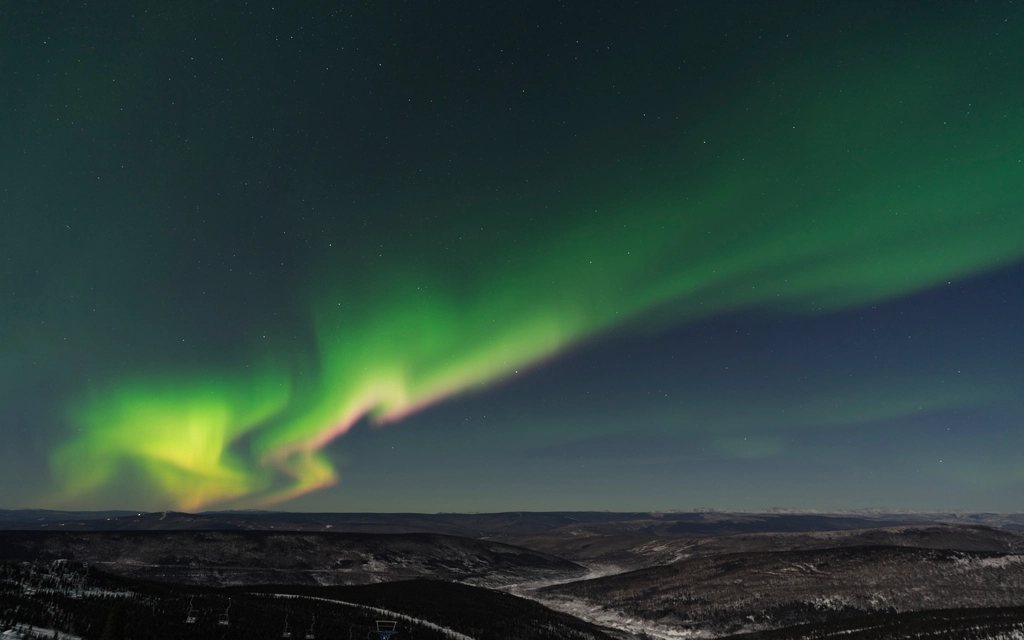
We have seen the northern lights from a cruise ship deck, from a highway pullout above Anchorage and from the roof of a cabin outside Juneau, and every one of those nights was a gift. But if someone gives us one week and one place to see the aurora in Alaska, we send them to Fairbanks without hesitation, and not because of anything in town. It is because of where the town sits on the map, what the sky above it does in winter, and a piece of physics that no amount of enthusiasm can argue with. This is the explanation we wish we had read before our first trip north.
Table of Contents
The oval, not the pole
The aurora does not happen at the North Pole. It happens in a ring around the magnetic pole called the auroral oval, roughly 1,500 to 2,000 miles (2,400 to 3,200 km) across, which glows most nights of the year whether anyone is watching or not. Fairbanks, at 64.8 degrees north, sits almost directly beneath the southern edge of that ring on a normal night. Anchorage, 260 miles (420 km) south, sits outside it and needs the oval to expand, which only happens during stronger storms. Juneau and the Panhandle are further south still and, worse, wetter. Utqiagvik, at the top of the state, is actually north of the oval on quiet nights and sees the lights to its south. The lesson is that latitude helps only up to a point, and 64 to 67 degrees is the sweet spot. The Interior of Alaska is that sweet spot, with roads, beds and an airport.
Why the sky matters as much as the map
The second reason is weather. Fairbanks has a continental climate: cold, dry and far from the storm tracks that soak the coast. Winter nights are frequently clear, and when a high-pressure system settles over the Interior the sky can stay cloudless for a week, even as the temperature falls to minus 30 or minus 40 (which is the same in Fahrenheit and Celsius). The mountain ranges to the south, the Alaska Range and the Chugach, wring the moisture out of Pacific air before it arrives. By contrast, the coast is under cloud on most winter nights. A brilliant display above Seward on an overcast night is invisible from the ground, and the coast is overcast far more often than not. Dry cold is uncomfortable, but it is what makes Fairbanks reliable enough that the local visitor bureau publishes an aurora season, running from August 21 to April 21, and a statistic we have found honest in practice: a visitor who stays three nights and goes out looking is very likely to see something.
The dark months and the best of them
The aurora is always there; the sun is the problem. Around the summer solstice, Fairbanks has civil twilight all night and no aurora can be seen, however strong. From late August the nights are dark enough, and by late September they are long. December and January offer 18 to 20 hours of darkness, but also the deepest cold and the most temperamental weather. Our favorite windows are the weeks around the equinoxes, in late September and in March. Geomagnetic activity is statistically higher near the equinoxes because of how Earth’s magnetic field aligns with the solar wind, and March adds long nights, milder temperatures, deep snow for foreground, and roads that are easier to drive. The moon matters less than people fear. A full moon lightens the sky and washes out faint displays, but it also lights the landscape, and a strong aurora over moonlit snow is a finer photograph than the same aurora over black nothing.
The KP index, explained simply
Every aurora forecast quotes a number from 0 to 9 called the KP index. It is not a brightness rating. It is a measure of how disturbed Earth’s magnetic field is, averaged over three hours from stations around the world, and its practical meaning is how far south the auroral oval has spread. At KP 0 to 2, the oval sits over Fairbanks and the lights can be seen there on a clear night, often low in the northern sky. At KP 3 to 4, the oval expands south over Anchorage and the Mat-Su. At KP 5 and above, which the forecasters call a geomagnetic storm, the lights can be overhead in Anchorage, visible from Juneau, and occasionally seen from the northern tier of the lower 48. What this means for a Fairbanks trip is liberating: the KP number barely matters. A KP 1 night with clear skies beats a KP 6 night under cloud every time. We check the cloud forecast first, the short-term aurora forecast second, and treat the KP figure as a hint about where in the sky to look, not whether to go out.
What is actually up there
The lights are made by charged particles from the sun, carried on the solar wind, guided down the magnetic field lines and colliding with the thin upper atmosphere between about 60 and 200 miles (100 to 320 km) up. Oxygen struck at around 60 to 150 miles glows green, the most common color and the one our eyes see best. Oxygen much higher up glows deep red, seen mainly in strong storms. Nitrogen adds purple and blue fringes at the lower edge of active curtains. The sun runs an 11-year cycle of activity, and the current cycle peaked through 2024 and 2025; the years just after a maximum have historically brought some of the biggest storms, which is good news for anyone planning the next few winters. A quiet display looks like a pale green arc that a newcomer might mistake for a cloud. Then, with no warning, the arc brightens, folds into curtains, and begins to move.
A night in the field
The routine that works for us is unglamorous. We sleep in the afternoon, eat early, and are outside from about ten in the evening until two or three in the morning, since local midnight in Fairbanks falls closer to one in the morning by the clock. We drive 20 to 30 minutes out of town to escape the glow: north toward the domes and ridges that overlook the city, or east along the hot springs road. We dress as for a night of standing still at minus 30, which means far more than for a hike at the same temperature, with boots rated well below what the thermometer says. For photographs we use a wide lens at its widest aperture, ISO 1600 to 3200, exposures of 3 to 15 seconds, manual focus set on a star before the fingers go numb, and a spare battery in an inside pocket. The camera sees more color than the eye, which is worth knowing to avoid disappointment. And when the sky finally goes quiet, we have learned not to leave. The best show of the night, more often than not, comes in the half hour after everyone else has gone to bed.