
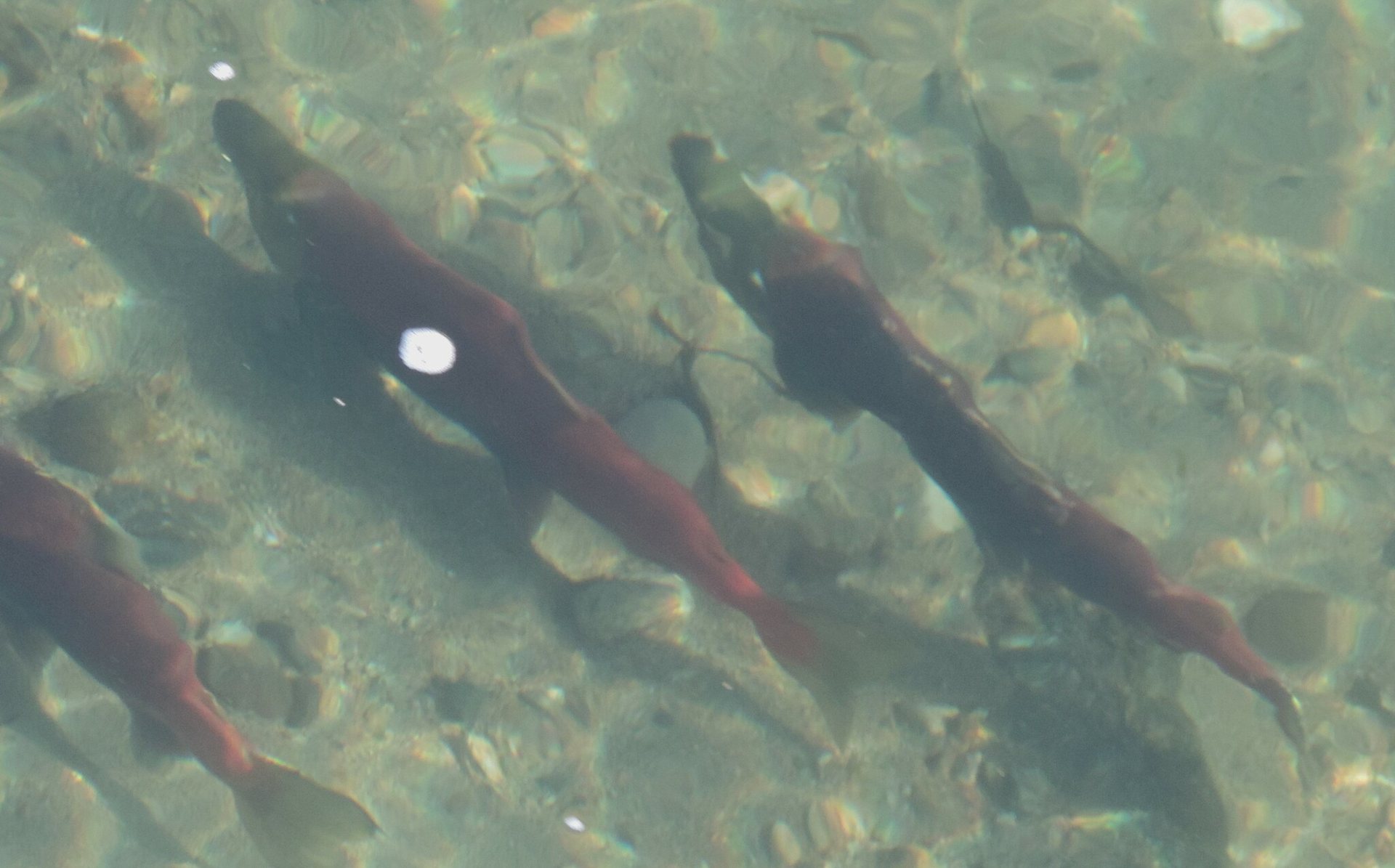
Salmon organize the Alaskan summer. Towns fill and empty on their schedule, bears move to the rivers when they arrive, and half the conversations in a Kenai Peninsula gas station in July are about which run is in and where. We came to fishing late and remain amateurs, but we have learned enough to plan a trip around the fish rather than hope for the best. What follows is a plain guide to the five Pacific salmon, the calendar they keep, and the rules as they work in practice.
Table of Contents
The five species and how to tell them apart
All five Pacific salmon spawn in Alaska, and each has two names, which confuses everyone at first. The king, or Chinook, is the largest and rarest; a typical fish runs 20 to 40 pounds (9 to 18 kg), and the sport-caught world record, a Kenai River fish from 1985, weighed just over 97 pounds (44 kg). Kings have black gums and small spots on both lobes of the tail. The sockeye, or red, is the fish on most plates: 5 to 10 pounds (2 to 4.5 kg), no spots, and in spawning colors a crimson body with a green head. The coho, or silver, arrives late and fights hard, usually 8 to 12 pounds (3.5 to 5.5 kg), with white gums and spots only on the upper lobe of the tail. The pink, or humpy, is the smallest and most abundant at 3 to 5 pounds (1.5 to 2 kg), with large oval spots on the tail and, on the males, the hump that gives the name. The chum, or dog salmon, runs 8 to 15 pounds (3.5 to 7 kg) and in fresh water shows purple-green vertical bars along its flanks.
The runs, month by month
Kings come first. In Southcentral, the early runs enter rivers in mid-May and peak through June; the late Kenai run arrives in July. A downtown creek in Anchorage sees hatchery kings in June, which is how many locals catch their first. Sockeye follow, with the first pushes into the Kenai and Russian rivers in mid-June and a larger second run peaking in the second half of July. Bristol Bay, in the southwest, hosts the largest sockeye run on Earth, tens of millions of fish in a few weeks of late June and July.
Pinks fill the rivers in July and early August. In Southcentral and Prince William Sound they are far more numerous in even-numbered years; in much of Southeast the strong years are the odd ones. Chum overlap with the pinks from July into August, especially in the Interior rivers and the big systems of the west. Coho close the season, entering coastal streams from late July, peaking in August in places like Valdez and the Kenai, and running into September and, in some rivers, October. By then the rivers are quiet.
Where to stand and how to fish
The Kenai Peninsula is the accessible heart of it, two to three hours by road from Anchorage. The confluence of the Russian and Kenai rivers is famous for “combat fishing,” where anglers stand at arm’s length along the bank during the sockeye run and a certain etiquette applies: cast in turn, shout “fish on,” and step back to let a hooked fish be played. Sockeye rarely bite; they are caught by a technique called flossing, in which a bare hook on a short leader is drifted through the fish’s open mouth. It looks like snagging and is legal because the hook lands in the mouth, and the regulations are precise about that distinction. Fly-fishing-only sections exist on the Russian and elsewhere, and some waters ban bait or restrict hooks to a single barbless point.
Kings are fished from drift boats with roe or lures in the deep glacial channels; coho take spinners and flies from the bank in the clearer streams; pinks will hit almost anything bright. Saltwater trolling from the ports of Seward, Homer, Whittier and Valdez targets kings and coho in the bays and adds halibut to the day. Dipnetting, in which a huge net on a pole is held in the current at the mouth of the Kenai, Kasilof or Copper rivers, is a personal-use fishery reserved for state residents and is the most Alaskan sight on the coast in late July.
The rules in general terms
Alaska takes its fisheries seriously, and the regulations are long, but the principles are simple. A sport-fishing license is required for residents from age 18 and nonresidents from age 16, sold by the day, the week or the year. Fishing for kings requires an additional king salmon stamp on top of the license. Bag limits are set per species, per day and per water, with an annual limit on kings in many areas. Rules differ between fresh and salt water, between rivers, and even between sections of the same river.
The single most important thing to understand is the emergency order. State biologists count fish on sonar and weirs through the season, and when a run comes in weak or strong they change the rules mid-season, sometimes overnight: closing a river to kings, adding a bonus sockeye to the daily limit, or opening a personal-use fishery early. Checking the current orders for your river the morning you fish is not optional. Rules also govern gear (hook size, number of hooks, bait), where you may fish from (the bank only in some places, no fishing within a set distance of a weir or a hatchery), and how fish must be recorded. Kings and some other species must be logged on the license itself before you continue fishing.
Bears, carcasses and sharing the river
Salmon rivers are bear rivers. On the Russian River and on many Southeast and Bristol Bay streams, brown bears fish the same riffles as people. The rules that keep both safe are mostly about food. Clean fish at designated stations or, where none exist, cut carcasses into pieces and throw them into deep, fast water so they wash away rather than pile up on the bank. Never leave a stringer of fish on the shore or in shallow water; a bear that learns that anglers mean fish is a bear that gets shot. Keep bear spray on your belt, not in the truck, and if a bear approaches while you have a fish on, break the line and back away. The fish was never yours.
A practical week
If we had one week and no experience, we would spend it on the Kenai Peninsula in the last ten days of July: sockeye at the Russian confluence at dawn, an afternoon of learning to floss with patience rather than force, a day of saltwater trolling out of Seward for coho and halibut, and an evening watching the dipnetters at the river mouth in Kenai. Bring waders, a rain jacket, polarized glasses and a fillet knife. Expect the license and the stamp to add up to a modest but real cost, and expect the fish, when it comes, to be the best you have ever eaten.