
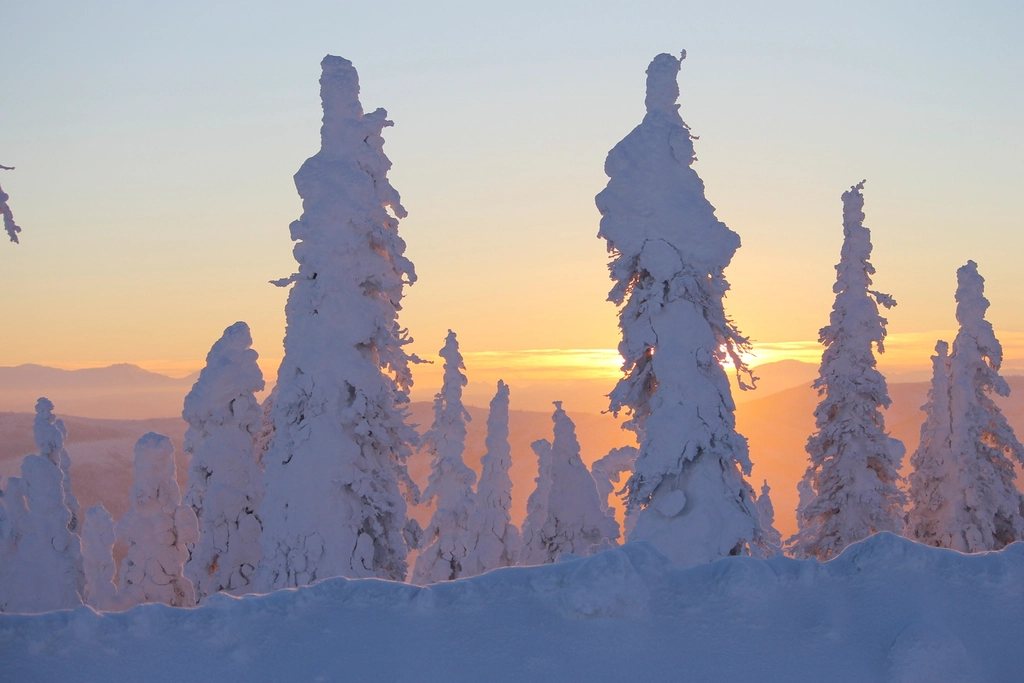
Ask a newcomer to name the seasons and they will give the four from the school calendar. Ask someone who has lived through a dozen Alaska winters and the answer comes back different: break-up, summer, termination dust and freeze-up, with a long dark stretch in the middle that everyone simply calls winter. These are not poetic labels. They mark real events that change how the roads drive, where the animals are, what the rivers do and whether a plan is possible at all. We have organized our own trips around this calendar for years, and it has served us far better than the equinoxes.
Table of Contents
Break-up: April to mid-May
Break-up is the season when the ice goes out. On the Tanana River at Nenana, a wooden tripod has been set on the ice every spring since 1917 and connected to a clock; when the ice shifts and the tripod moves, the moment is recorded to the minute, and a statewide guessing game pays out to whoever came closest. The ice has gone as early as April 14 and as late as May 20. Across the state, break-up means mud. Snow that fell in October melts in three weeks, the ground beneath is still frozen and cannot absorb it, and every trail, road shoulder and campground turns to standing water. Frost heaves buckle the highways, potholes open overnight, and many trails close to protect them. Then, quite suddenly, green-up: in Fairbanks the birches leaf out in a matter of days around the middle of May, the sandhill cranes and swans return to the wetlands, and the smell of thawing spruce is everywhere.
Summer: June, July, August
The Alaska summer is short, intense and organized around fish. King salmon run into the rivers from late May through July, sockeye peak in June and July, silvers arrive in August and hold into September, and the calendar of every coastal town follows the runs. Fireweed, the tall magenta flower on every roadside, serves as a clock: it blooms from the bottom of the stalk upward, and the old saying holds that when the last flowers open at the tip, snow is six weeks away. June is the driest and brightest month in most of the state and the worst for mosquitoes, which peak from mid-June into July in the Interior and on the tundra. July is warmest; Fairbanks averages highs near 73 F (23 C) and can pass 90 F (32 C), while Anchorage, tempered by the sea, sits around 66 F (19 C). August is wetter, especially in Southcentral and Southeast, where it is often the rainiest month of the year, but it brings blueberries, the first cool nights and a thinning of the crowds. Summer is also fire season in the Interior, where lightning ignites the boreal forest most years; in 2004 more than 6.5 million acres (2.6 million hectares) burned, and a smoky August in Fairbanks is not unusual.
Termination dust: late August to September
One morning in late August or early September, the peaks above town are white again. Alaskans call that first high snow termination dust, because it terminates the summer, and its arrival is discussed the way people elsewhere discuss the first frost. In the Alaska Range and on the Denali park road it can come in the third week of August; in the Chugach above Anchorage it is usually the first or second week of September. It coincides with the finest few weeks of the year. The tundra turns red and gold in Denali around the end of August, the birches of Southcentral peak in the second half of September, the bugs are gone, the bears are fat and visible, bull moose are in the rut and the aurora is back in a sky that finally gets dark. The cost is that the machinery of summer shuts down fast. The park road buses in Denali run their last trips in mid-September, ferry schedules thin, campgrounds close their water, and the gravel highways of the Interior become a gamble after the first serious snow. We consider the first two weeks of September the best-value fortnight in Alaska, provided the trip is built to bend.
Freeze-up: October and November
Freeze-up is break-up in reverse and just as awkward. The lakes around Fairbanks skin over in the middle of October, the small rivers by the end of the month, and the great rivers of the Interior, the Yukon and the Tanana, sometime in November. Anchorage sees its first lasting snow on average in the middle of October. For a few weeks there is neither open water for boats nor thick enough ice to travel on, the trails are a crust of frozen mud, and rural communities off the road system wait for the ice to be safe before the winter trails open between villages. Once it freezes solid, the state expands. Snowmachines and dog teams follow river highways that do not exist in summer, ice roads are graded across the tundra to the North Slope, and skiers get the first real base in the mountains. The daylight, meanwhile, is draining fast: by the end of November Fairbanks has under five hours of it.
Winter: December through March
At the winter solstice, Anchorage manages about five and a half hours between sunrise and sunset and Fairbanks under four, with the sun barely clearing the southern hills. In Utqiagvik it does not rise at all from mid-November until late January. Cold is the other constant. January in Fairbanks averages a high near minus 8 F (minus 22 C), and cold snaps to minus 40 and beyond are a normal feature of most winters, while Anchorage, warmed by the ocean, is usually 20 to 30 degrees milder. What surprises visitors is how much happens in these months. Late February brings a week-long winter carnival to Anchorage, and on the first Saturday in March the thousand-mile sled dog race to Nome starts from downtown. March itself is many locals’ favorite month: twelve hours of daylight and climbing, deep snow, bright skies and temperatures that have turned the corner. By the end of March, in the Interior, the snow is still deep but the sun has real warmth in it.
Reading the calendar for a trip
The practical lesson is that Alaska’s seasons do not divide the year evenly, and a trip should be timed to what a traveler most wants. Long light, salmon and every road and boat running mean mid-June to mid-August. Color, wildlife, aurora and fewer people mean the fortnight either side of termination dust. Skiing, mushing, hot springs and the northern lights at their most reliable mean late February to the end of March. Break-up and freeze-up are the seasons to avoid unless the aim is to see the state as it lives for itself, muddy and half-frozen, waiting. Whatever the month, the one certainty is change: an Alaskan year moves faster and further than any calendar in the lower 48, and the people who live here count it not by dates but by what the river, the sky and the mountains are doing that morning.
1 thought on “Break-Up, Summer, Termination Dust and Freeze-Up: Alaska’s Year as Alaskans Count It”
Comments are closed.