
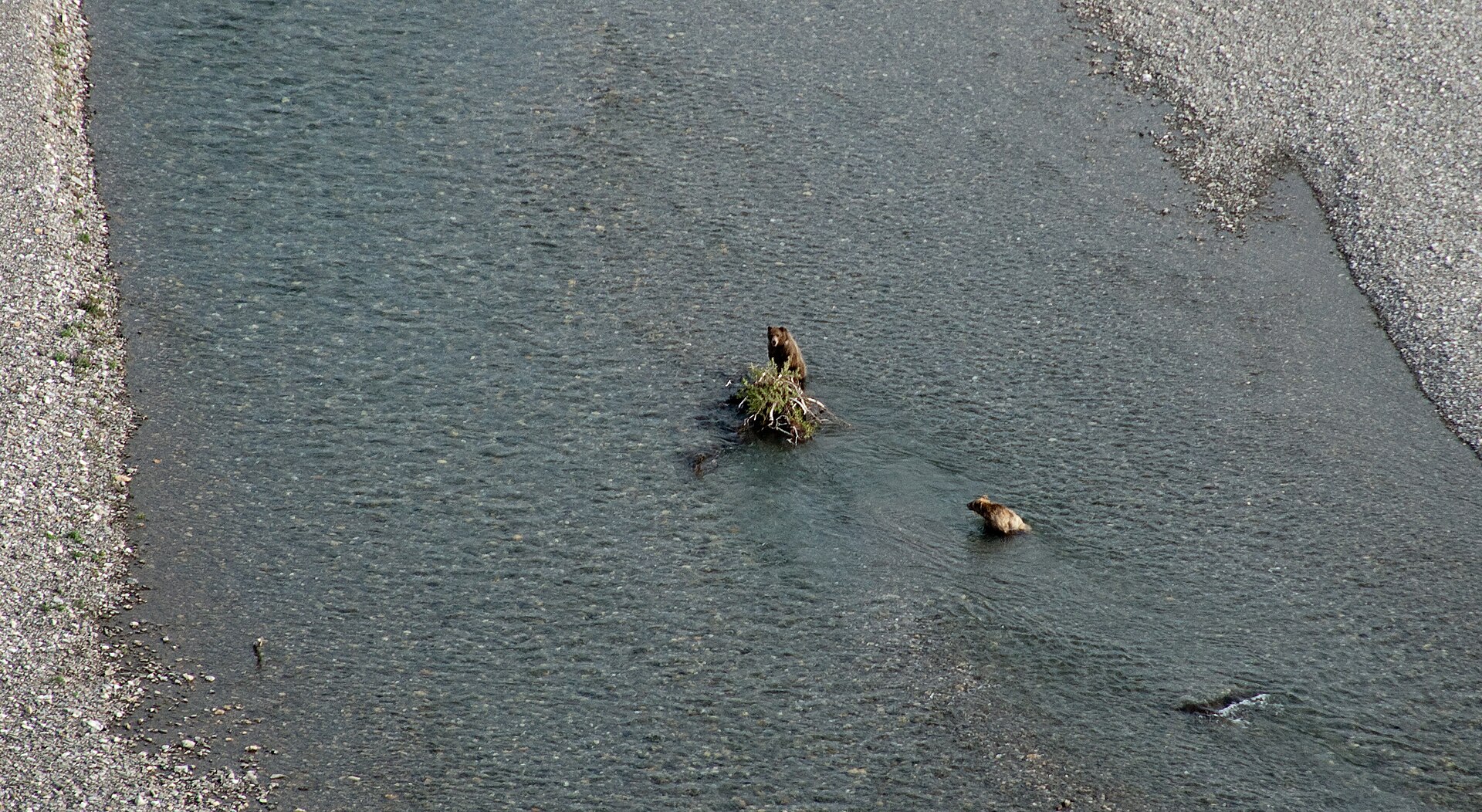
The reliable pattern is to match the animal to its place: salmon rivers for brown bears, tundra and mountain country for caribou, cold coastal water for humpbacks. This guide explains that logic first, then how to watch each animal well.
Table of Contents
Why does Alaska have so much wildlife?
Wildlife here is shaped by space and by food. Animals gather where and when that food appears, which is why timing matters as much as location.
The variety is wide. The state’s wildlife includes bears at the top of the food chain, moose and caribou, wolves, foxes, otters, hundreds of bird species, seals, sea lions and migratory whales. Even a single city shows the range: the Anchorage area alone supports 52 species of mammals and at least 230 species of birds, according to a wildlife plan from the state’s fish and game department.
The practical lesson is that you do not need a remote expedition to see something. You do need to decide which animals matter most to you, because that decides the region, the month and whether you want a guide.
Which bears live in Alaska, and where do you look?
Three kinds of bear live in the state, and they live in different places for different reasons.
- Brown bears (the same species as grizzlies) are found across most of Alaska. The state holds about 98% of the US brown bear population, and an estimated 30,000 live here. Kodiak Island has its own subspecies, the largest brown bear in the world.
- Black bears are smaller and live mostly on the mainland, preferring forest. As many as 100,000 are thought to live in the state. They are the bears most likely to wander near towns and camps.
- Polar bears stay along the Arctic coast.
For brown bears, the dependable setup is a salmon stream in summer. Katmai National Park is known for one of the densest brown bear populations in the world, and the Brooks River draws bears to the salmon climbing upstream, with viewing platforms built so people can watch from a safe position. Lake Clark and Kenai Fjords are other places where bears are watched, and McNeil River Falls has one of the highest brown bear densities in the state.
Why does a guide help? Not because bears are rare, but because an experienced guide knows where bears are feeding that week and how to position a group without crowding them. Bears are most dangerous at a fresh kill and when a sow has cubs, so distance and calm behavior matter more than a good camera angle.
Black bears deserve a separate warning. The wildlife plan for Anchorage describes how bears drawn to garbage, pet food and birdseed can become public safety hazards. The risk comes from food left out, not from the bear’s nature, so store food and trash securely wherever you stay.
How do caribou and moose fit into a trip?
Caribou are the animal of open country. The state’s caribou are found mainly on tundra and in mountain regions with few trees, although many herds winter in the boreal forest. In Alaska the word reindeer refers only to domesticated caribou. Estimates of the total number vary by source, from more than 750,000 to about 950,000, so treat any single figure as a rough scale: it is a very large population.
The key habit to understand is movement. Caribou are strongly migratory and can cover up to 50 miles in a day, driven by weather and food. That means a herd is never guaranteed at a given spot. Plan for the region and the season, stay flexible, and treat a sighting as a bonus rather than a promise.
Both sexes grow antlers, which is unusual among deer. Males usually carry the larger set, and females shorter, more irregular ones, which helps you tell them apart through binoculars.
Caribou also matter to people. Alaska Natives rely on caribou for food, and the Nunamiut people of northern Alaska have a connection with the animal said to span more than 10,000 years. Changes in migration are a real concern for those communities, a good reminder that you are watching a food source and not only a spectacle.
Moose are the opposite case: they live close to people. Neighborhood and trail encounters with aggressive moose are a stated concern in Anchorage’s wildlife plan. Give a moose plenty of room, especially in town, and never assume an animal near a path is calm because it looks unbothered.
What marine animals can you see from the water?
The coast adds another set of animals, and humpback whales are the most visible. They travel to Alaska’s waters each summer from warmer areas near Hawaii or Mexico to feed on krill and small fish. They were once on the endangered species list and were delisted in 2016.
Humpbacks are watchable because of how they behave. They breach, slap their tails and wave their flippers, and some groups use bubble-net feeding: whales blow bubbles around a school of fish to herd it into a tight cluster, then swim up through the middle with mouths open.
The Inside Passage and Glacier Bay are strong choices in summer. About 600 whales are estimated to use Glacier Bay National Park and the surrounding waters, alongside sea otters, sea lions, porpoises and orcas. Boats are the practical way to watch, and guided trips handle the distance and the positioning for you.
The reasoning is simple. Whales follow food, and food in cold water peaks in summer, so a summer boat trip in sheltered waters gives you the best odds with the least effort. If whales are your main goal, choose the sea over the road.
How do you watch Alaska’s animals well and safely?
Good wildlife watching comes down to a few habits that apply to every species above.
- Choose the place before the animal. Salmon rivers, tundra, and coastal water each have their own species, so pick the setting that fits what you want to see.
- Keep your distance. Use binoculars or a long lens instead of moving closer. Surprised or threatened bears are the main danger.
- Carry bear spray and make noise on trails. Hiking in a group and staying alert reduces the chance of surprising a bear.
- Store food and trash properly. Garbage, pet food and birdseed teach bears to approach people, which usually ends badly for the bear.
- Consider a guide for bears and whales. Knowledge of local movements turns a hopeful outing into a likely one.
- Accept uncertainty. Migratory animals like caribou move on their own schedule, so build slack into the plan.
These are small decisions, but they are the reason one traveler sees a bear fishing at a river and another sees only empty water. Plan around the animals’ food and seasons, respect their space, and the encounters tend to follow.
Related reading
- Break-Up, Summer, Termination Dust and Freeze-Up: Alaska’s Year as Alaskans Count It
- Humpbacks, Orcas and Sea Otters: A Month-by-Month Guide to Alaska’s Marine Wildlife
Sources
- Living with Wildlife in Anchorage — Chapter 4, … (adfg.alaska.gov, accessed 2026-11-02)
- Alaska’s Wildlife: 7 Iconic Animals of the Great Land (offthebeatenpath.com, accessed 2026-11-02)
- Wildlife of Alaska — Wikipédia (en.wikipedia.org, accessed 2026-11-02)
Photo: Alaska Animals (50327705673), by BLM Alaska, Public domain (Wikimedia Commons)
