
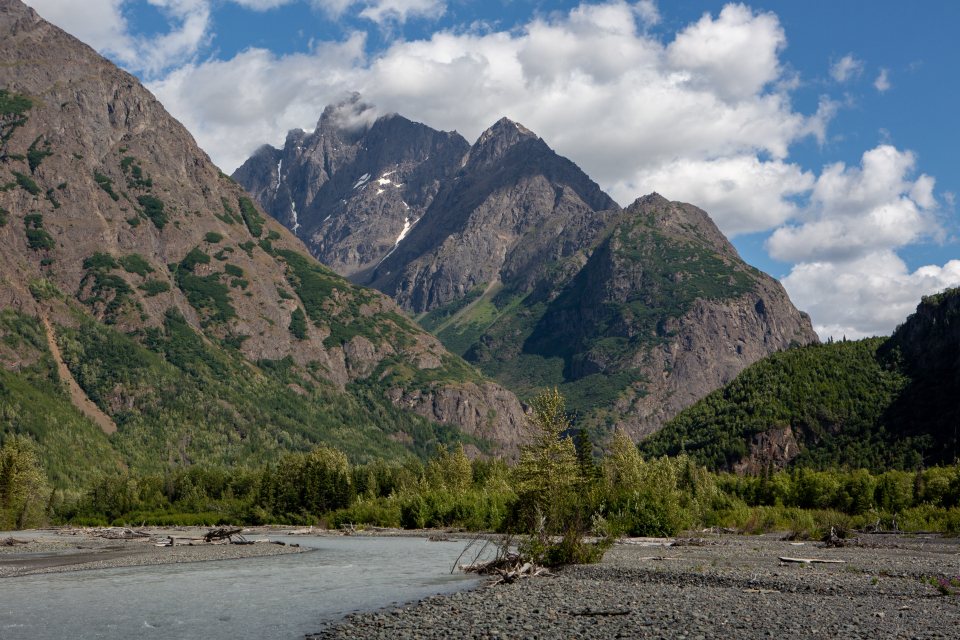
Anchorage is one of the few cities in North America where a serious mountain hike starts twenty minutes from downtown. The Chugach front range rises straight out of the eastern suburbs, and the state park that protects it, at roughly 495,000 acres (200,000 hectares), is bigger than some countries we have visited. We have spent more evenings up there than we can count, and we still find new corners. This is our guide to the hikes we send friends to first, and to the small habits that keep those trailheads open for everyone.
Table of Contents
Flattop: the most-climbed mountain in Alaska
Flattop Mountain tops out at 3,510 feet (1,070 m), and its broad summit table is visible from most of the city. The standard route leaves the Glen Alps trailhead at about 2,200 feet (670 m) and gains roughly 1,350 feet (410 m) over about 1.5 miles (2.4 km) one way. Most people take two to four hours round trip, with a long pause on top to look across Cook Inlet toward the volcanoes on the far shore and, on a clear day, toward Denali far to the north.
The first two-thirds are easy walking on a well-built path around the Blueberry Loop and up a series of switchbacks. The last few hundred feet are different: a steep scramble through a rock band where hands are useful and the “trail” splits into a dozen braids. The rock is loose, and a fall here is the most common way people get hurt on the mountain. Go slowly, keep your group together, and pick your way down the same line you came up rather than trying a shortcut. Snow lingers in the summit gully well into June, and the wind on top can be twice what it is at the car. A shell, a hat and gloves belong in the pack even in July.
Beyond Flattop: the front range in a day
The same trailhead opens onto the Powerline Pass trail, a broad valley track that runs about 5.5 miles (9 km) to the pass at around 3,550 feet (1,080 m) with views into the heart of the range. It is gentle enough for a family, and moose are very likely along the willows. Branch off partway and the Williwaw Lakes route climbs into a bowl of tarns beneath Mount Williwaw, a long day of roughly 13 miles (21 km) round trip that rewards patience.
Little O’Malley Peak, at about 3,270 feet (1,000 m), sits just east of Flattop and is a quieter alternative with a similar climb. Wolverine Peak, reached from the Prospect Heights trailhead a few miles north, is our favorite front-range summit: 4,455 feet (1,360 m), about 10.5 miles (17 km) round trip and around 3,400 feet (1,040 m) of gain, with a ridge walk that feels far bigger than the distance suggests. Near Point, from the same trailhead, is the shorter cousin at about 3,050 feet (930 m).
To the south, the McHugh Creek trailhead on the Seward Highway gives access to Rabbit Lake, a 14-mile (22.5 km) round trip beneath the twin peaks of Suicide Peaks, and to McHugh Peak itself. Farther down the highway, Bird Ridge climbs about 3,500 feet (1,070 m) in a little over 2 miles (3.2 km) and is the first snow-free trail of spring because it faces south over Turnagain Arm. Your knees will remember it.
Timing, weather and the light
The main hiking season on the front range runs from early June, once the upper trails melt out, to late September, when the tundra turns red and the first snow dusts the ridges. In midsummer the light barely fades, and a start at 7 in the evening is entirely reasonable; we have been on Flattop at midnight in late June and read a map without a headlamp. Autumn brings the best walking: firm ground, no bugs and berries everywhere.
Mountain weather here moves fast off the Gulf of Alaska. A blue morning in town can be fog and sideways rain at 3,000 feet by noon. Check the forecast, but also look at the ridges from the city before you leave. If the tops are in cloud and the wind is bending the birches, pick a valley walk instead of a summit.
Moose, bears and the space they need
Moose are the animal that will actually cause you trouble on the Hillside trails. They are common, they are calm until they are not, and a cow with a calf in May or June will charge without much warning. Give them at least 50 yards (45 m), more if a calf is present, and step off the trail into the trees rather than trying to pass. Black bears are regular visitors in the lower brush, and brown bears move through the valleys every summer. Make noise on blind corners, keep dogs leashed where required and under close control everywhere else, carry bear spray where you can reach it, and never leave a pack unattended with food in it.
Trailhead etiquette that keeps the gates open
The Glen Alps lot holds a few hundred cars and fills by mid-morning on summer weekends. When it is full, the road below is narrow, residential and subject to towing. Arrive early, arrive late, or choose another trailhead. Here is the short list of habits that we consider non-negotiable on the front range:
- Pay the daily parking fee or carry an annual state park pass; the fee funds the trails and the rangers who maintain them.
- Park only in marked spaces. Blocking the road or a neighbor’s driveway is the fastest way to lose community goodwill for the park.
- Stay on the main line through the Flattop scramble and on the tundra above. Braided shortcuts erode into gullies within a season or two.
- Pack out everything, including orange peels and dog waste bags. Nothing decomposes quickly at this elevation.
- Keep music in your headphones and keep drones grounded; the quiet is what the mountain offers.
- Leave a note with someone about your route and your return time. Cell coverage fades once you drop behind a ridge.
What to carry for an evening on the ridge
These are day hikes, but they are Alaskan day hikes. We carry a windproof shell, an insulating layer, a hat and gloves, a liter or two of water, real food, a small first-aid kit, a headlamp outside of June and July, a paper map, and traction devices for the shoulder seasons when the upper switchbacks are ice. Trail shoes are fine on the Powerline trail; boots with ankle support earn their weight on Wolverine and Bird Ridge. Above all, carry the willingness to turn around. The summit will be there next week, and in Anchorage next week is only twenty minutes away.