
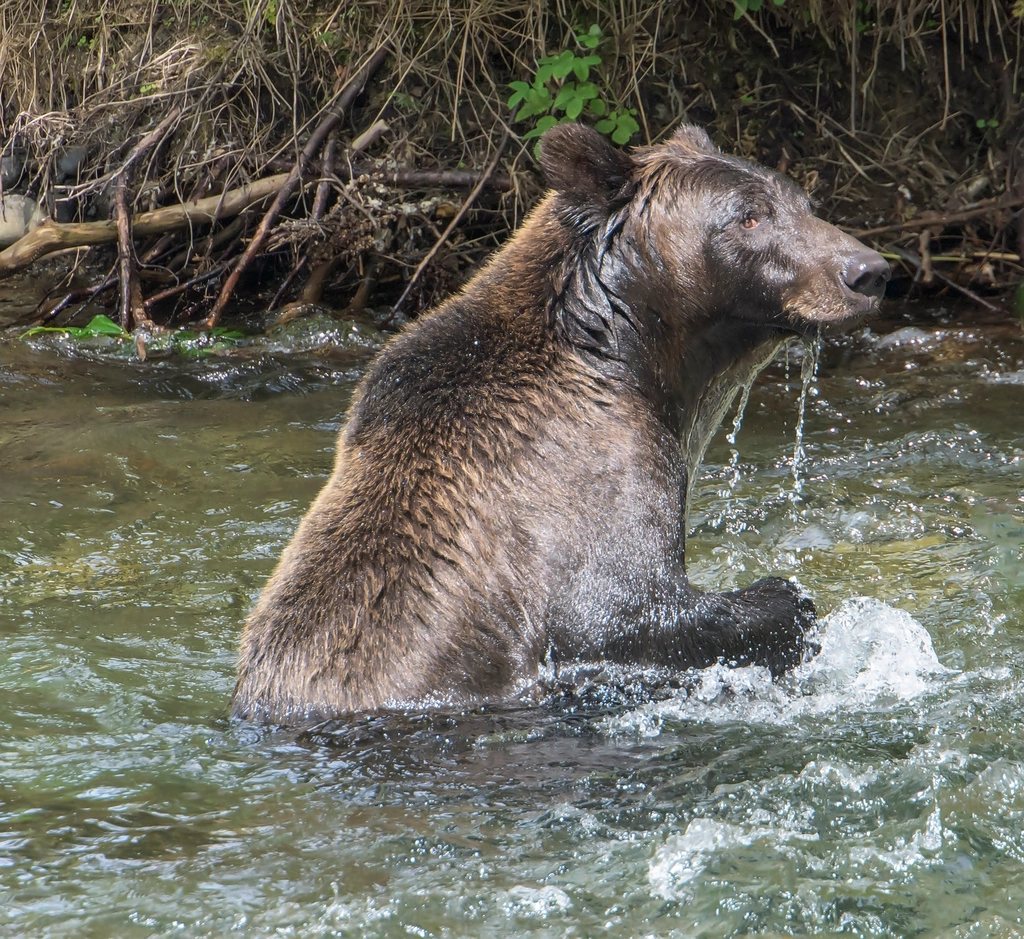
Alaska is the only state where all three North American bears live within the same borders. Roughly 100,000 black bears occupy the forests from the Panhandle to the Yukon River, around 30,000 brown bears range from the Kenai to the Brooks Range, and a few thousand polar bears hunt the sea ice of the Chukchi and Beaufort seas. We have spent enough summers here to know that the animals are rarely the problem. The problem is usually us: where we camp, what we cook, and how close we drift when the camera comes out. This is our field guide to telling the three apart, to the places where watching is safe and reliable, and to the discipline that keeps a trip from becoming a story a ranger tells at a briefing.
Table of Contents
Telling the three apart
Color is the least reliable clue. Black bears in Alaska come in black, cinnamon and, on a few islands of Southeast, a rare bluish-gray phase called the glacier bear. Brown bears range from blond to nearly black. What separates them is shape. A brown bear carries a distinct shoulder hump, a dished face and long, pale front claws built for digging; a black bear has a straight profile, taller ears and short dark claws for climbing. Size overlaps more than people expect. A coastal brown bear on Kodiak or the Katmai coast can exceed 1,000 pounds (450 kg) after a salmon summer, while an interior grizzly of the same species, living on roots, berries and ground squirrels, may weigh a third of that. Polar bears are unmistakable: long necks, small heads, and a range that only touches the northern and western coasts. Black bears are absent from Kodiak, the Seward Peninsula and everything north of the Brooks Range, which simplifies identification in those places considerably.
Where the watching is reliable
The great viewing sites are all built on salmon. On the Alaska Peninsula, a wooden platform above a set of falls in Katmai National Park lets visitors watch brown bears catching sockeye in early July and again in September, when the fish are spent and the bears are fat. Nearby, a state sanctuary on the McNeil River limits visitors to a few permit holders a day, chosen by lottery, and rewards them with the densest gathering of brown bears on Earth. Across the Gulf, Admiralty Island in Southeast holds an estimated 1,600 brown bears, about one per square mile (2.6 sq km), and a managed viewing area at Pack Creek. Near Wrangell, a creek called Anan draws both black and brown bears to a pink salmon run in July and August, one of the few places where the two species fish side by side. On the road system, the park road in Denali offers a chance of grizzlies on open tundra, though from a bus rather than a boardwalk. For polar bears, the village of Kaktovik on the Beaufort Sea sees animals gather on a barrier island in September and October, waiting for the sea ice to return. All of these sites use permits, seasonal windows or daily quotas, and most require a floatplane or boat; planning starts months ahead.
Distances, and what the numbers mean
Every management agency in Alaska publishes distances, and they are not suggestions. In Katmai, the rule is 50 yards (46 m) from any bear and further from a sow with cubs. In Denali, it is 300 yards (275 m) from bears and 25 yards (23 m) from everything else. On most state land, the standard we use is simpler: if a bear changes its behavior because of us, we are too close. The sites above are safe because bears there have learned that people on platforms are neither food nor threat, a truce built over decades of predictable human conduct. That truce does not travel. A bear on a beach in Prince William Sound has no such training, and the same 50 yards can be far too little. We carry binoculars and a long lens for a reason.
Camp discipline in bear country
The habits that matter most happen at camp, not on the trail. We separate sleeping, cooking and food storage into a triangle with sides of at least 100 yards (90 m), with the tent upwind of the kitchen. In Denali, Katmai and many other parks, a bear-resistant food container is required for backcountry travel, and we use one everywhere north of the treeline, where there is nothing to hang a bag from. Everything with a smell goes in it: toothpaste, sunscreen, the fish-smelling shirt, the empty wrapper. We cook away from the tent, eat every scrap, strain dishwater and scatter it well away, and never bring food or the clothes we cooked in into the sleeping area. On the coast, we camp below the high tide line only for the night, so the tide takes our scent by morning. These rules feel fussy on day one and automatic by day three.
Encounters, and the spray on our hip
Bears avoid surprise. We talk on the trail, especially in brush, along streams and into the wind, and we walk in groups when we can. If a bear notices us and stands, it is trying to see and smell, not threatening. We speak calmly, wave our arms slowly, and back away without running, because running triggers a chase and a bear covers 100 yards in about six seconds. A brown bear that charges is usually bluffing and stops short; we hold our ground and reach for the spray. Bear spray works out to about 25 feet (8 m), is more effective than firearms in the hands of most people, and must ride on the hip or chest strap, not in the pack. It cannot fly in checked luggage on most carriers, so we buy it on arrival and give it away at the end. The distinction that matters in the rare event of contact: a defensive brown bear is discouraged by playing dead, face down with hands over the neck, while a black bear or any bear that is stalking or entering a tent must be fought with everything at hand.
Reading the season
Bears keep a calendar and so should we. In May and early June they graze sedge flats at tidewater and can be seen from a kayak at a respectful distance. July brings the first salmon and the crowds at the falls. August is berry season, when bears wander through blueberry patches that are also hiking routes; we make more noise then, not less. September is the last feast before denning, and bears are single-minded and bold. By late October most brown bears in the Interior are underground, though coastal bears may stay out into December where food remains. Polar bears reverse the pattern, most visible in the fall gap between the last open water and the first firm ice. Whatever the month, the animal at the center of the frame is the least important variable. The distance, the wind and the state of our camp are the ones we control, and they are the ones that decide how the story ends.
Read next: Northern Lights in Alaska: The Best Time to Go and Why the Season Is Wider Than You Think