
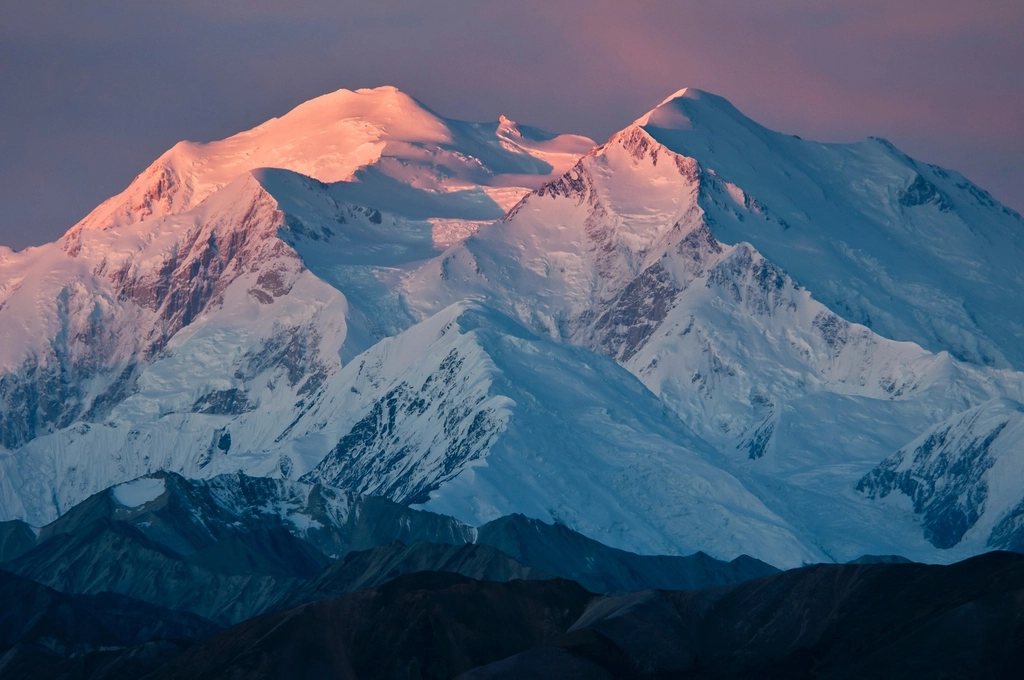
Denali is the mountain almost everyone comes to see and roughly two-thirds of visitors never do. That single fact shapes everything about a visit to Denali National Park and Preserve: the one gravel road, the buses that run along it, the way a clear morning can empty a campground in ten minutes. We have made the trip in rain, snow and blue August weather, and our advice is the same each time: go for the land and the animals, and treat the summit as a gift.
Table of Contents
A very large park with a single road
The park covers about 6 million acres (2.4 million ha), larger than the state of New Hampshire, and it has exactly one road into it. The entrance sits at mile 237 of the Parks Highway, about 240 miles (386 km) north of Anchorage and 120 miles (193 km) south of Fairbanks, and it is also served by the summer passenger train that runs between the two cities. From the entrance the Denali Park Road runs 92 miles (148 km) west to the old mining settlement of Kantishna, and it has been kept deliberately narrow, unpaved beyond mile 15 and free of private cars for most of its length since 1972. That decision is the reason wolves, grizzlies and caribou are still seen from the road at all.
The first 15 miles (24 km) to the Savage River are paved and open to anyone with a vehicle. This stretch has trailheads, the kennels where the park’s working sled dogs live, and, at mile 9, the first possible view of the mountain on a clear day. Beyond the Savage River check station the road belongs to the buses, cyclists and walkers.
How the buses work, in general terms
There are two families of bus. Transit buses are the plain green ones: no narration, cheaper, and you can get off anywhere it is safe to stop, walk for as long as you like, then flag down a later bus with empty seats to continue or return. Tour buses are narrated, include a snack or lunch, and keep to a fixed schedule. Both leave from near the entrance, both stop for wildlife, and both are booked to a turnaround point: the Toklat River at mile 53, the visitor center at Eielson at mile 66, or Wonder Lake at mile 85 when the road is open that far. A separate camper bus carries backpackers and people with campground reservations deeper into the park. Tickets sell out on peak July dates, so we book them early and build the trip around them.
The road itself is the reason to ride. It climbs from spruce forest at the entrance to open tundra at Sable Pass, where the whole valley floor is grizzly habitat and walking off the bus is prohibited, then hangs on the side of Polychrome Pass with a drop of several hundred feet below the wheels. Highway Pass at 3,980 feet (1,213 m) is the high point, and from Stony Hill just beyond it, on a clear day, Denali fills the windshield less than 40 miles (64 km) away. A round trip to Eielson takes about eight hours; to Wonder Lake, closer to eleven. Bring layers, food, water and patience with the dust.
One honest caution: for several recent summers a landslide at Pretty Rocks, near mile 45, cut the road beyond the East Fork of the Toklat. A bridge has been built over the unstable slope, but how far the buses run each season is decided by the park, so check before you set your heart on Wonder Lake.
Seeing the mountain
Denali rises to 20,310 feet (6,190 m), the highest point in North America, and because its base sits at only about 2,000 feet (600 m), it has more vertical relief than Everest seen from its base camps. That bulk makes its own weather. Moist air from the Gulf of Alaska piles up against the range, and the summit is wrapped in cloud roughly two days out of three in summer. Your odds are best early in the morning, after a cold front has cleared the air, and in general better in late August and early September than in July, although nothing is guaranteed.
Inside the park the classic views are from mile 9, from Stony Hill and from Eielson, where the mountain stands 33 miles (53 km) away across the Thorofare River. Outside the park, the south side is often clearer: pullouts on the Parks Highway between miles 135 and 163, and the riverbank at Talkeetna, look straight at the summit from 60 miles (97 km) or more. If the forecast is good on the day you arrive, drop everything and look, because tomorrow may be gray.
Walking in a park with almost no trails
Denali has only a handful of maintained trails, all near the entrance: the Horseshoe Lake loop, the climb to the Mount Healy Overlook with about 1,700 feet (520 m) of gain in 2.7 miles (4.3 km), the Savage River loop and the longer Triple Lakes Trail. Beyond Savage River the park expects visitors to walk cross-country on tundra and gravel bars, and it is one of the great pleasures of the place. Get off a transit bus at a ridge that looks good, walk up it for an hour, and you will very likely have it to yourselves. The rules are simple and firm: stay at least 300 yards (275 m) from any bear, give moose and caribou room, never approach wolves, and keep every scrap of food in the bear-resistant containers the park lends to backpackers. Overnight permits are issued per zone, in person, a day or two ahead, so backpackers should arrive with flexible plans.
Wildlife, and the value of a slow bus
The five animals everyone hopes for are grizzly bear, moose, caribou, Dall sheep and wolf. Sheep are the most reliable, white dots on the slopes above Igloo Creek; caribou drift across the Toklat gravel bars; grizzlies dig roots on the tundra of Sable Pass; moose stay low in the willows near the entrance. Wolves are luck. Every passenger is a spotter, and a good driver stops for as long as an animal is in view, which is why a full day on the road is rarely boring even in rain.
Seasons, costs and the shape of a visit
Buses run from about the third week of May to the middle of September. June has the longest light and the most mosquitoes; August brings blueberries and the first gold in the tundra; the second week of September, when the road is opened for a few days to a lottery of private cars, is the most beautiful and the most uncertain, with snow possible any day. In winter the road is plowed only to park headquarters at mile 3, and the park belongs to skiers, mushers and the silence. Fees and bus tickets are modest by Alaska standards; lodging outside the gate is not, and the busiest weeks fill months ahead. Three nights is the minimum we would give it: one full day on the road, one for a walk near the entrance or a second bus, and a spare day held in reserve for the mountain, in case it decides to appear.