
The first whale of an Alaska summer usually announces itself as a sound rather than a shape: a long exhale carrying across flat water at six in the morning, then the slow arch of a back and a tail lifted like a signature. We have watched from ferry decks, kayak seats, headlands and the bow of small boats, and the best sightings have never been about luck alone. They have been about timing. Alaska’s marine life runs on a calendar set by migration, salmon and ice, and a trip planned around that calendar will see more in a single day than a poorly timed week. Here is how we read it.
Table of Contents
Humpbacks: the summer residents
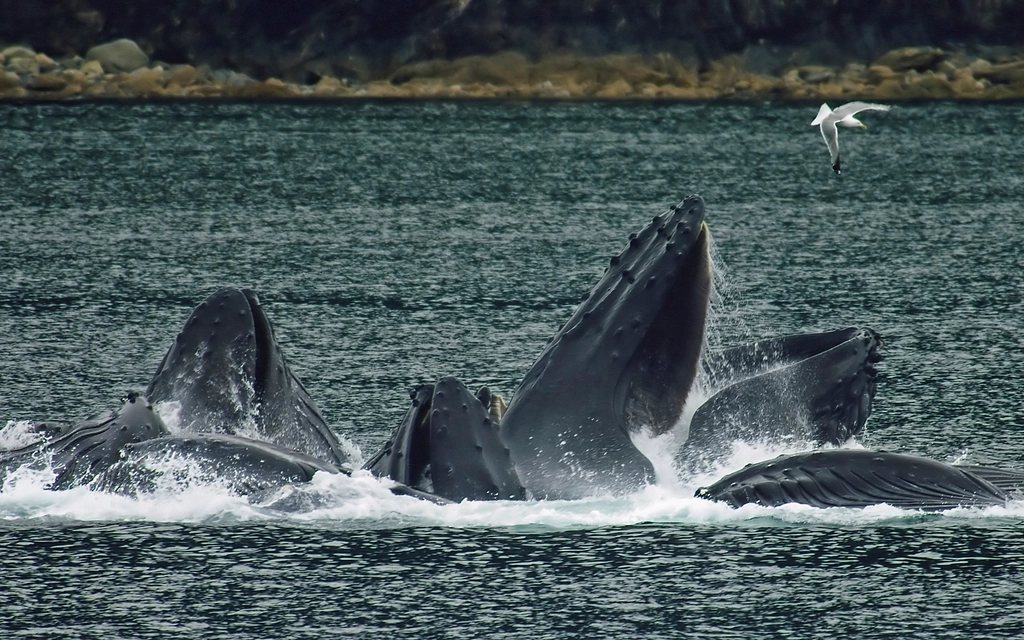
Most of the humpback whales that feed in Alaska spend winter breeding in Hawaiian waters, about 3,000 miles (4,800 km) to the south, and swim north without eating. The first arrive in April, the bulk in May and June, and by July the sheltered waters of Southeast, the Kenai Fjords and Prince William Sound are as full of whales as they will get. They stay to feed on herring and krill until September and October, when the water cools and the long swim south begins. For a visitor, June through August is the safe window, with early September a fine and quieter alternative. The behavior worth planning around is bubble-net feeding, in which a group of whales dives, exhales a spiral of bubbles to corral a school of herring, then lunges through the center with mouths open. It is most often seen in the straits and sounds of the Panhandle in July and August, and it is one of the few things in nature that reliably makes a boat full of adults go silent.
Orcas: two kinds, two diets
Orcas, the largest of the dolphins, are here all year, but they are not one population. Resident pods eat fish, mainly salmon, travel in large stable family groups and vocalize constantly. Transient pods, often called Bigg’s killer whales, hunt seals, sea lions, porpoises and even the calves of larger whales; they move in small groups and stay quiet to avoid alerting prey. Both are found in Resurrection Bay, Prince William Sound and the inside waters of Southeast. Residents are most predictable from May to September, when salmon are running into the fjords. Transients are less tied to season and more to the presence of seals on the ice near tidewater glaciers, which makes June, when harbor seal pups are born on floating ice, a strong month for them. The tall, straight dorsal fin of a male, up to six feet (1.8 m), is visible from a surprising distance in calm conditions.
The spring migrations
Before the humpbacks arrive, gray whales pass along the outer coast on one of the longest migrations of any mammal, roughly 10,000 miles (16,000 km) round trip between Baja California and the Bering and Chukchi seas. They round the Kenai Peninsula and Kodiak from late March into May, close to shore, and are the reason the first whale-watching trips of the year leave Seward in April. In the far north, bowhead whales, the only large whale to live its whole life in Arctic waters, move past Utqiagvik in April and May through leads in the sea ice, and the Inupiat communities of the coast hold a subsistence harvest regulated by quota that has continued for more than a thousand years. Visitors do not go out on the ice, but the spring whaling season shapes the calendar and the culture of the northern villages, and it is worth understanding with respect before arriving there.
Belugas, sea otters and the rest of the cast
Cook Inlet, on Anchorage’s doorstep, holds a small and endangered population of beluga whales, white as the whitecaps and numbering only a few hundred. They follow fish into Turnagain Arm in spring and again in August and September, and a pullout on the Seward Highway a few miles south of the city is the easiest place in Alaska to see a whale without leaving a car. Sea otters are the opposite of rare today, but they were hunted almost to extinction in the fur trade before an international treaty in 1911 protected them; Alaska now holds most of the world’s population. They raft in kelp beds in Kachemak Bay, Resurrection Bay, Prince William Sound and Sitka Sound in every month of the year, floating on their backs with pups on their chests. The fur that nearly finished them is the densest of any animal, up to a million hairs per square inch, and it is why they can live in 40-degree (4 C) water without blubber. Around them in summer swim Steller sea lions, harbor porpoises, Dall’s porpoises that ride a boat’s bow wave, and on the cliffs, horned and tufted puffins that arrive in May and leave by late August.
Where to stand, and when
Our shortlist of places is short because the good ones are so good. The Kenai Fjords out of Seward combine humpbacks, orcas, otters, sea lions and tidewater glaciers on a single day trip from June to August. Prince William Sound, reached from Whittier or Valdez, adds harbor seals on ice. In Southeast, the straits around Juneau, the waters near Sitka and the long ferry runs of the Inside Passage deliver humpbacks on almost every summer crossing, and a ferry ticket is the cheapest whale watch in the state. Kachemak Bay from Homer is the otter capital and a fine place for a kayak morning. For a rough calendar: April for gray whales and the first humpbacks, June for seal pups and orcas on the ice, July and August for the fullest water and bubble nets, September for whales feeding hard before they leave. Fog is common on the outer coast in July and August, and the calmest water is nearly always before ten in the morning.
Distance, law and the better photograph
Federal law prohibits harassing marine mammals, and in Alaska the working guideline is 100 yards (90 m) from whales, with vessels expected to slow and never to cut across a whale’s path. Kayakers have a particular responsibility, since a paddler is silent and a whale that surfaces beside a boat has not been given a chance to avoid it. We keep our distance, let the animals close it if they choose, and put the camera down when they do. Sea otters and seals hauled out on rocks are disturbed far more easily than they look; if heads come up, we are too close. None of this costs a sighting. The whale that crosses under a drifting kayak on a still morning in Aialik Bay, unhurried and unbothered, is the one we remember, and it only happens when the boat is quiet and the people in it are patient.
1 thought on “Humpbacks, Orcas and Sea Otters: A Month-by-Month Guide to Alaska’s Marine Wildlife”
Comments are closed.