
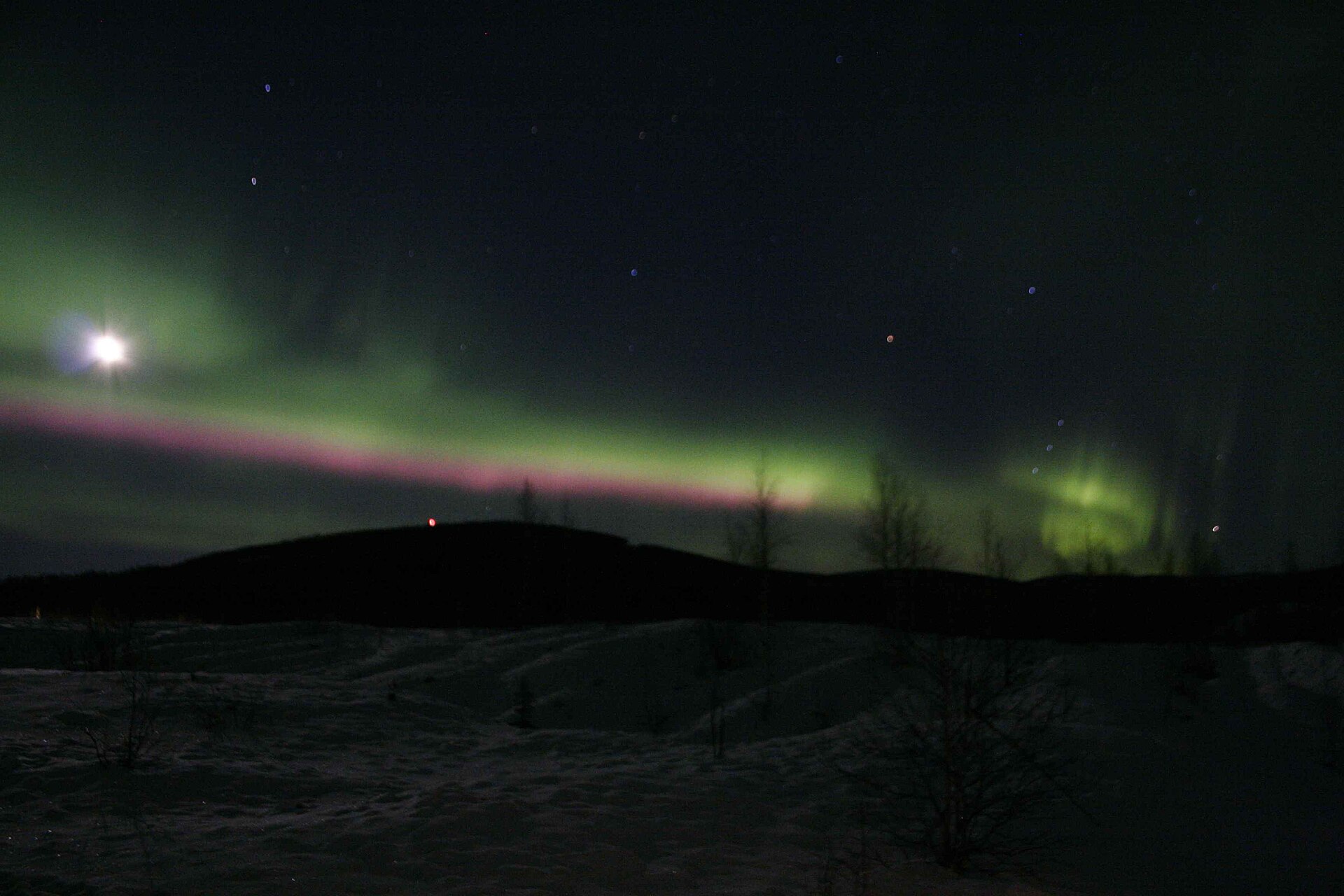
The aurora can be seen in Alaska from late August to late April, wherever the sky gets properly dark. Within that window, the months around the equinoxes tend to favor activity, and the hours around midnight give the darkest sky. This guide explains why those patterns exist, so you can choose your dates by reasoning rather than by rumor.
Table of Contents
When does the aurora season actually start and end?
The aurora is not a winter-only event. It is always happening high above the planet. What changes through the year is whether the sky is dark enough to show it. In Fairbanks, true night disappears around the summer solstice, and only twilight remains. Because of that, roughly two months on either side of the solstice are poor for viewing.
One Fairbanks guide who photographs the lights puts the workable window between August 21st and April 21st. Another operator describes the broader viewing season as September through April, when nights are long and dark. These two ranges differ only at the edges, and the reason is simple: the dark hours return gradually in late summer and fade gradually in spring.
A common belief says the lights vanish on April 1st. The guide mentioned above calls this a myth, and it matters for planning, because it keeps many travelers away from a period with real advantages, covered below.
The practical lesson is that you do not need to travel in deep midwinter. Choose the dates that fit your life, then use the rest of this article to improve your odds within them.
Why do the months near the equinox get more credit?
Aurora forms when charged particles streaming from the sun interact with Earth’s magnetic field. How well the two connect depends partly on the orientation of the solar wind relative to Earth’s field. According to one Fairbanks guide, that alignment is somewhat better shortly after the equinoxes than around the solstices. The result, on average, is an estimated 20 to 30 percent more induction of the solar wind, which raises the chance of an active display.
This does not mean Earth’s seasons change the sun. The solar wind itself is unaffected. What shifts quasi-seasonally is how the planet’s magnetic field lines up with it. On that basis, September, October, March and April carry better odds than the months in between.
A second operator makes a related point: around an equinox the geometry syncs well with the magnetic field of the solar wind, so chances look excellent. Both explanations point to the same practical conclusion.
Keep the claim in proportion. Better odds are not a promise. A strong display can appear in any month of the season, and a weak week can happen even at the equinox. Treat the equinox bump as a tilt in your favor, not a guarantee.
Why do some guides favor April, and others March?
Darkness and solar activity are only two of the variables. Weather is the third, and it is the one travelers ask about least. A sky full of falling rain or snow hides the lights just as thoroughly as a bright city does.
One Fairbanks guide argues that April is the best month for four reasons:
- It sits just after the spring equinox, when active aurora is slightly more likely.
- Historical records show the driest stretch of the whole season falling between April 11th and April 20th.
- It is far warmer than the other months, apart from August and September, which bring much more precipitation.
- Fewer visitors come because of the April 1st myth, which tends to mean lower prices and smaller crowds.
A reader comment on that same page offers a different experience. After going in September, they found the month wet and almost always cloudy, and said they would choose March next time, since March has few days of rain while still being peak season. Taken together, the two views agree on the principle: dry, clear nights matter as much as solar activity, and September is the wettest of the shoulder months.
If you can pick freely, March and April are strong candidates. If a trip must happen in autumn, accept that cloud is the main risk and plan extra nights to absorb it.
What time of night should you be outside?
The window with the darkest skies runs from 9 p.m. to 3 a.m. The Geophysical Institute at the University of Alaska Fairbanks gives the same window for prime viewing, with midnight as the best single moment. This is called solar midnight, and it is the center of the dark period rather than the number on a clock.
Here is why the hours matter. The aurora can be bright for hours, but it is also unpredictable from one night to the next. Watching it works much like fishing: you put your line in the water and wait. Going out around midnight, away from artificial light, and then waiting patiently gives the display its best chance to be seen.
A Fairbanks dog-sledding company adds a blunt but useful reminder. Many visitors travel north specifically for the lights, then go to bed and miss them. Because no one can say when the sky will become active, the only dependable method is to keep your eyes on it.
Plan for late nights and quiet days. Schedule early-morning activities sparingly, and treat the evening as the main event of your trip.
Where should you be, and how many nights do you need?
Location decides how often the lights appear. Alaska sits under what is called the auroral zone, a band where the lights are most frequent. The zone is described as lying between 65 and 70 degrees north latitude, and the Alaskan places named as best are in the northern part of the state: Fairbanks, Denali and the North Slope. Coldfoot, Prudhoe Bay and Utqiagvik are also named as good viewing sites.
Coldfoot is worth a closer look if you want a remote setting. It is a small settlement on the Dalton Highway, a truck-stop community with a restaurant and a limited number of rooms. Beyond it, the road offers no services for about 240 miles until Deadhorse. That isolation is exactly what keeps the sky dark, though it also means you must plan fuel, food and lodging carefully.
For most travelers, the number of nights matters more than the exact town. Two sources repeat the same figure: a person who spends three or more nights in the viewing zone has about a 90 percent chance of seeing the lights. Treat that as a reason to stay several nights rather than a single one.
Finally, sky conditions shape the result. Clearer skies improve the odds, although one operator notes the lights can show through scattered cloud and even light snow flurries. A heavy overcast is another matter, and no forecast of strong activity can overcome it.
Practical steps that help
- Dress in layers, since long, still nights outside are cold.
- Bring a camera and a tripod for steady long exposures.
- Check a live aurora forecast, such as the one on the Geophysical Institute website, but treat it as a short-range tool.
- Move away from town lights to a lake shore, a mountaintop or a quiet road.
On the forecast point, one Fairbanks guide says outlooks are reasonably accurate only within about three days, and even then predicted Kp levels do not translate well into real sightings for interior Alaska. Weeks or months ahead, the guide compares picking the best night to choosing a lottery ticket. Build flexibility into your schedule instead of betting on one date.
Related reading
- Humpbacks, Orcas and Sea Otters: A Month-by-Month Guide to Alaska’s Marine Wildlife
- Break-Up, Summer, Termination Dust and Freeze-Up: Alaska’s Year as Alaskans Count It
Sources
- Guide to Viewing the Northern Lights in Alaska (alaskatours.com, accessed 2026-11-04)
- When is the best time to see the aurora? (fairbanksauroratours.com, accessed 2026-11-04)
- When is the Best Time to See the Aurora in Fairbanks? (arcticdogco.com, accessed 2026-11-04)
- Coldfoot, Alaska — Wikipédia (en.wikipedia.org, accessed 2026-11-04)
Photo: Northern lights Alaska aurora borealis lights at night, by Primmer, Rich and Rose, U.S. Fish and Wildlife Service, Public domain (Wikimedia Commons)
