
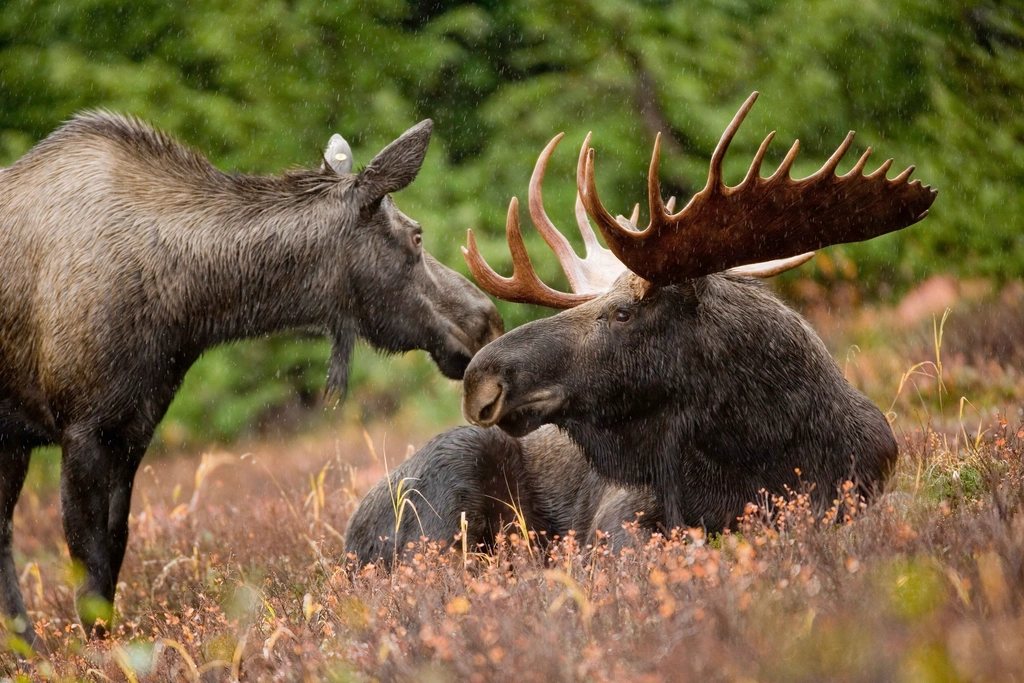
Bears get the headlines, but the animals a visitor is most likely to meet in Alaska are the three big grazers: the moose in the willows at the edge of town, the caribou streaming across tundra in a line that takes an hour to pass, and the Dall sheep picked out white against a gray cliff a thousand feet above the highway. We have spent more hours watching these three than any bear, and we have learned that each asks for something different from the person watching. The moose asks for caution, the caribou for patience, and the sheep for good glass and a willingness to sit still on a cold rock.
Table of Contents
Moose: the neighbor with a temper
Alaska holds somewhere between 175,000 and 200,000 moose, the largest members of the deer family on Earth. A mature bull stands up to seven feet (2.1 m) at the shoulder, weighs 1,200 to 1,600 pounds (545 to 725 kg), and carries antlers that can span six feet (1.8 m) by September. They live wherever willow, birch and aspen grow: river floodplains, burned forest, the edges of lakes, and the greenbelts of Anchorage, where roughly 1,500 moose share a city of 290,000 people. On the Kenai Peninsula, in the Mat-Su Valley and along the Parks Highway, they are a fixture of the roadside. The animal is not aggressive by nature, but it is enormous, defensive and unpredictable when pressed, and more people are injured by moose in Alaska each year than by bears. The two dangerous seasons are late May and June, when cows have newborn calves and will charge anything that comes between them, and late September into October, when bulls in the rut lose their judgment entirely.
Reading a moose, and what to do
A moose that intends to charge tells us first. It stops feeding and stares. Its ears go flat back, the long hair on its hump rises, it may lick its lips or lower its head and take a few stiff steps forward. Any of these signs means we have already come too close, and the answer is the opposite of the bear rule: we back off quickly, and if it comes, we run, putting a tree, a car or a building between ourselves and the animal. Moose rarely pursue far; they want distance, not a fight. Dogs are the commonest trigger of a charge, since a moose treats every dog as a wolf, and the dog invariably runs back to its owner. Park rules in Denali set 25 yards (23 m) as the minimum for moose and other animals, and on a suburban trail that is a sensible number too.
Caribou: the herds and where the road meets them
Alaska’s caribou number around 750,000 animals in roughly 30 herds, and unlike moose they are almost never alone. The great herds of the north, the Western Arctic and the Porcupine, each count in the hundreds of thousands and migrate hundreds of miles a year between calving grounds on the coastal plain and winter range in the boreal forest. Caribou are the only deer in which both sexes grow antlers, and their wide, splayed hooves work as snowshoes, paddles and shovels for digging lichen from beneath the snow. For a visitor on the road system, three places stand out. The Denali park road crosses the range of the small Denali herd, a few thousand animals scattered across the tundra between Sable Pass and Wonder Lake all summer. The Dalton Highway, beyond Atigun Pass at 4,739 feet (1,444 m), reaches the coastal plain where the Central Arctic herd gathers in June and July, sometimes within sight of the road. And the Denali Highway, a 135-mile (217 km) gravel road between Cantwell and Paxson, crosses the fall range of the Nelchina herd, where in late August and September groups of bulls with velvet-shed antlers move across the high country in full view.
Dall sheep: the white dots on the cliff
Dall sheep are the thing that made Alaska’s most famous park. Denali was established in 1917, largely to protect the sheep of the Alaska Range from market hunters feeding the gold camps, and the park road still offers some of the finest sheep viewing anywhere, particularly in the gorges around Igloo Canyon and the slopes above Polychrome Pass. About 45,000 of them live in the state, on the steep, dry, windswept slopes of the Chugach, the Alaska Range, the Wrangells and the Brooks Range. They are pure white, which makes them easy to spot and hard to reach: ewes and lambs, born in mid-May and early June, spend the summer on cliff ledges where nothing with paws can follow. Rams carry curling amber horns that grow throughout their lives and record each winter as a ring; a full curl takes seven to eight years. The most accessible sheep in Alaska stand above the Seward Highway at Windy Corner, about 20 minutes south of Anchorage on the shore of Turnagain Arm, where they come down almost to the road in spring and early summer to lick minerals from the rock. A second roadside herd lives on Sheep Mountain along the Glenn Highway.
Glass, light and patience
The single purchase that transforms wildlife watching in Alaska is a pair of eight- or ten-power binoculars, and for sheep and caribou a small spotting scope on a lightweight tripod earns its weight on the first day. Distances here are vast; a caribou herd two miles (3 km) off across a valley is a normal sighting, and a sheep at 1,500 feet (460 m) above the road is a white speck without magnification. We look in the first hours after sunrise and the last hours before sunset, which in June means before seven in the morning and after eight at night, and we scan edges: the line where willow meets open ground for moose, the rim of a ridge against the sky for sheep, the pale gravel of a river bar for caribou moving to water.
Sharing the country
All three animals are subsistence foods for Alaska Native communities and for rural Alaskans generally, and a visitor will see meat racks, hides and antlers in villages and at camps along the roads. That is not a spectacle; it is a way of life older than the state, and it deserves the same respect as the animals themselves. On the practical side, we never feed wildlife, never approach a calf that appears alone, since the cow is almost always close, and never put a person between a photograph and an animal’s escape route. The reward for that restraint is out of proportion to the effort. A morning spent above Windy Corner with a scope, watching a band of rams pick their way across a ledge no wider than a hand, is one of the quietest and most memorable things a person can do in the state, and it costs nothing but time and a warm jacket.
Read next: Animals in Alaska: Bears, Caribou, Whales and Where to Meet Them